Menu
Biography
Personal Statement
"Confined Spaces" a short profile of Bryn Harrison by James Saunders
Overcoming Form: Reflections on Immersive Listening by Bryn Harrison and Richard Glover. See here for links to PDF or hard copy versions.
Right click here to download pdf of my doctoral thesis.
Biography 
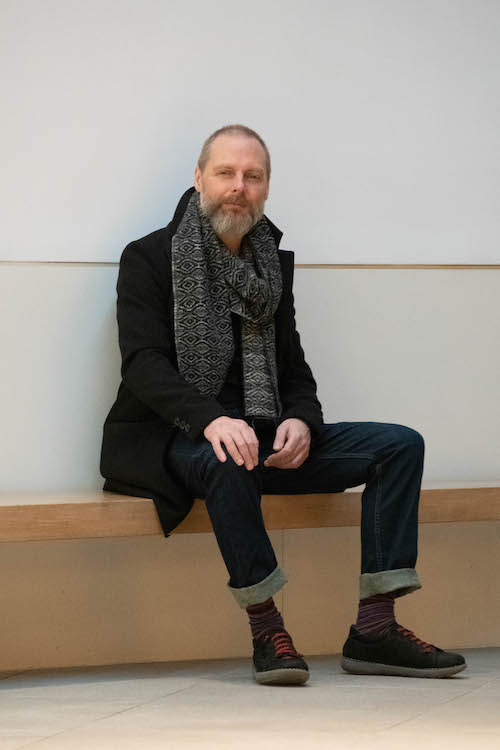
Bryn Harrison (b.1969) is a composer and Professor in Composition at the University of Huddersfield from where he obtained a doctorate in composition in 2007. He has developed a close working relationship with ensembles such as Plus-Minus, Asamisimasa, Elision, Exaudi, Apartment House, Bozzini Quartet, Wet Ink as well as with oloists such as Philip Thomas, Mark Knoop and Aisha Orazbayeva. In addition, his pieces have been performed by many other established ensembles such as Ensemble Recherche, Klangforum Wien, the London Sinfonietta, the London Symphony Orchestra, with notable performances and radio broadcasts from international festivals across the world.
As a composer, he has a long-held fascination with notions of musical time. Throughout his twenties and early thirties, he produced a steady output of solo and ensemble works, and in the process, developed an individual approach to dealing with time as a circular and repeating entity. Many of his subsequent works such as Surface Forms (repeating) (2009) operate at a speed and density that cannot be easily or immediately apprehended; they gradually draw the listener into an experience of the passage of time. More recently, he has continued to work with cyclical structures in a series of compositions of long duration that includes the 45-minute ensemble works Repetitions in Extended Time (2008) and Receiving the Approaching Memory (2014), and the 76-minute solo piano piece Vessels (2013). Over the past three years, his compositional research has focussed upon the ways in which memory operates in music. His hour-long Piano Quintet (2017) draws on a world of vanishings, recollections, apprehensions and remembrances. More recent works, such as Dead Time (2019), consider the use of highly-repetitive digital loops within the context of live instrumental settings.
He has co-authored two books: Overcoming Form: Reflections on Immersive Listening, (with Richard Glover) University of Huddersfield Press, 2013 and, with Jennie Gottschalk and Richard Glover; Being Time: Case Studies in Musical Temporality, Bloomsbury 2018. Bryn Harrison is a recipient of the prestigious Paul Hamlyn Foundation Award for Composers.
Statement
Bryn Harrison: Time, memory and recursive structures
Much of my recent compositional output has been largely concerned with the exploration of musical time through the use of recursive musical forms which challenge our perceptions of time and space by viewing the same material from different angles and perspectives. Pieces such as four cycles (2004-6) for large ensemble and shifting light (2006) for orchestra make use of circular pitch structures to create a musical continuum that operates largely outside the confines of a more conventional goal-orientated approach to form and structure.
More recent pieces such as repetitions in extended time (2008), Surface Forms (repeating) (2009) and Receiving the Approaching Memory (2011) attempt to take this idea a stage further by dealing directly with the opposition of static and mobile structures. Exploring high levels of repetition that draw on the pretext outlined by Hulme that exact repetition changes nothing in the object itself but does change something in the mind that contemplates it, these works deal explicitly with aspects of duration and memory through which near and exact repetition operate in close proximity throughout and provide points of orientation and disorientation for the listener.
Bryn Harrison (2015)
Confined Spaces: a short profile of Bryn Harrison
In July 2006, Bryn Harrison invited thirty composers whose work he admired to create new pieces to be placed in a time capsule, where they will remain in sealed envelopes for the next twenty-five years before being opened and performed for the first time in 2031. The concept for this project is apt for a composer whose principal interest is in the passing of time, exploring how it might operate in a non-teleological way, trying to slow it down, or suspend it momentarily. His music often presents a series of quasi-repeating panels, moments in which similar material might be marginally stretched or compressed. In his Listenings I (2001), a single repeating violin gesture, superimposed on a sequence of densely chromatic pedalled piano chords, is subtly altered on each hearing. Although the music is repetitive, it never repeats. Harrison uses the space created by this near cloning of material to interrogate our perception of change, a questioning which underpins all of his work. Recent pieces take this a stage further: Piano Set (2005) comprises six literal repeats of the same, complexly notated material and the single-page ensemble piece a leaf falls on loneliness (2007) is repeated 27 times. As Harrison states, 'All of our expectations tell us that something needs to change but I'm equally interested in finding out what happens when things don't. What's that Eno Oblique Strategy? "overtly resist change"'. Whilst this year's hcmf commission Repetitions in Extended Time (2008) is not directly repetitive to this degree, its 43-minute duration and concentration on a single event emphasise this precarious situation, challenging us to consider the narrow space between difference and repetition. Although of extended duration, these recent pieces mark a distinct break from his earlier work with its nod to late-Feldman. Whereas before they were like evolving things, now they're like objects that are obsessively re-examined.
Like Feldman, Harrison has maintained an interest in painting, particularly the work of Bridget Riley and friend Mike Walker, and it has taken a central role in his work since the ground (2000). In 2003 his fascination with Riley's curve-drawing techniques led to devoting a considerable amount of time to learning to draw them himself, resulting in Six Symmetries (2004) for large ensemble. These sketches formed the basis for developments in his own compositional techniques, whereby pitch patterns proliferate across an ensemble texture with a wave-like motion which makes an audible link to their initial source. Pitch in his music has been almost exclusively organized in a cyclical way. Meandering sequences are typically looped at different rates with registral displacement in the individual voices of an ensemble texture, blurring the focus and suggesting fields rather than lines despite its explicitly contrapuntal construction. Rhythmic material is normally separately conceived, using repeating frames of action in which the disposition and density of events is in flux. The mismatch between these two domains creates a drifting heterophony, perhaps most clearly heard in the In Nomine After William Byrd, a hcmf commission in 1999.
Harrison was born in Bolton in 1969, and studied first at Leeds College of Music (1988-91). There he developed an interest in composition, spurred on by his yearly attendance at hcmf, beginning in 1991. In addition to deepening his knowledge of contemporary music, the festival gave him some early performances of his work, most notably Frozen Earth played by Irvine Arditti and Mieko Kanno in 1995. From 1994-6 he studied for an MA with Gavin Bryars, before freelancing until his appointment as a lecturer at the University of Huddersfield in 2006, with a PhD following in 2007. He is currently Head of Composition at the university. His work has been performed by many of the leading European ensembles, including ensemble recherche, Apartment House, London Sinfonietta, [rout], Ixion, Klangforum Wien, asamisimasa, plus-minus ensemble and London Symphony Orchestra, and at festivals including Wien Horgange, Ultraschall, Hannover Biennale, Gaudeamus, Festival Klangspuren, Europaischer Musikmonat, Wittener Tage, Ostrava, Paris Festival Automne and the ISCM World Music Days (Yokohama, 2001).
Whilst the scores of timepieces 06/31 have only completed a tenth of their internment, Harrison has already shown a propensity for change that is reductive in nature, consistent with the fabric of the music itself. As work which seeks to alter our experience of time, it is perhaps appropriate that he continues to examine the beauty inherent in near stasis.
James Saunders
September 2008
Reproduced by kind permission of the author and the 2008 Huddersfield Contemporary Music Festival